
Safe Kids Conversations: 30 calm scripts to talk with your child about staying safe
Your child can be messaged in a game, asked for a photo, offered a lift or told to keep a secret on an ordinary day, and may not know what to say. Short, ready-to-say conversations on body safety, online safety and staying safe out in the world, with printable cards and help lines for Australia, the US, the UK and Canada.
- For children ages 3 to 12: online safety (8 to 12), body safety (3 to 8) and safety out and about (5 to 12)
- 30 scripts: words you can say, what your child might say back, and one small thing to try
- Seven printable cards for the fridge (A4 and US Letter)
- Phone-friendly, A4 and US Letter PDFs, instant download
- A guide for what to do if your child tells you something worrying
30-day money-back guarantee. If it is not for you, ask for a refund. Read the conditions
One payment of US$14.99, digital download, no subscription. Secure checkout by Stripe. We collect a parent email only, never anything about children.
Educational material, not a substitute for professional advice or child protection services. If a child is in immediate danger, call your local emergency number (000 in Australia, 911 in the US and Canada, 999 in the UK).
Six things your child can meet on an ordinary day, and the first three arrive through a screen
Most children never meet a dangerous person. But these situations are everyday ones, and the online ones need no school gate: a game, a chat or a phone puts a stranger into your child's room without a door opening. The adults who harm children rarely look like monsters. They look friendly, ask for secrets and count on a child not knowing what to say.
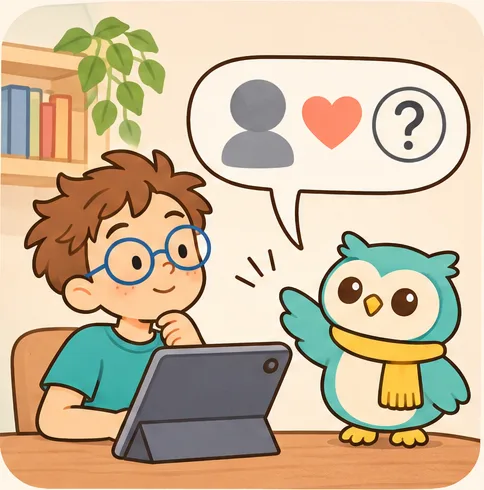
A friendly stranger in the game chat
Someone in a game asks where your child goes to school, then suggests moving to a private chat. It feels like a new friend.
In the book: Scripts 13 and 19
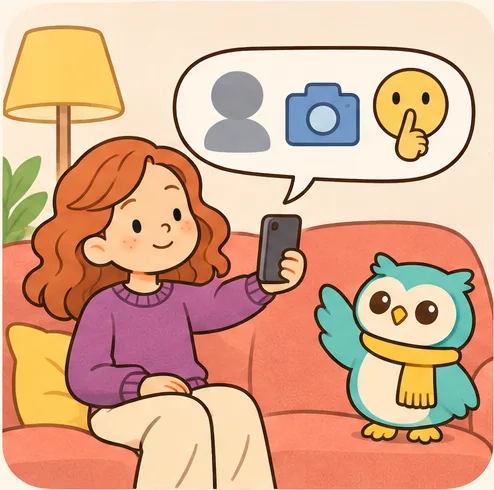
"Send me a photo. Don't tell anyone."
A message asks for a picture and adds that it is a secret. Pressure often follows if your child says no.
In the book: Scripts 14 and 15
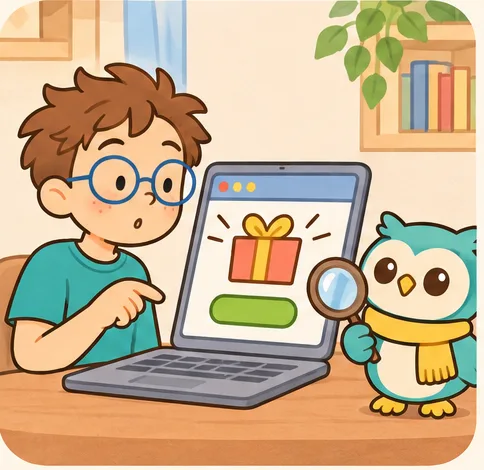
The "free gift" pop-up
A pop-up promises free items if your child clicks, signs in or shares a password.
In the book: Scripts 11 and 20
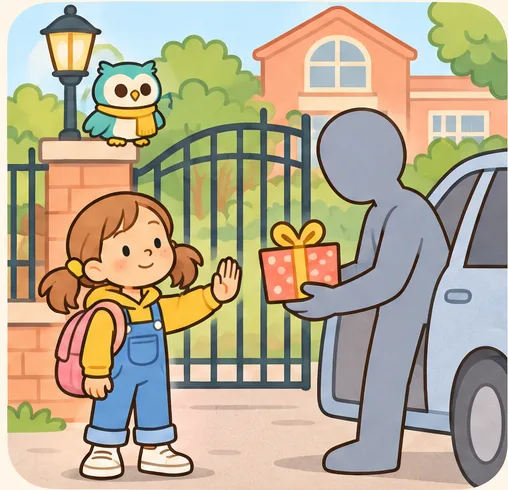
A gift and a lift at the school gate
Someone your child half knows offers a present, then a ride. Your child may not know what to say.
In the book: Scripts 22 and 27
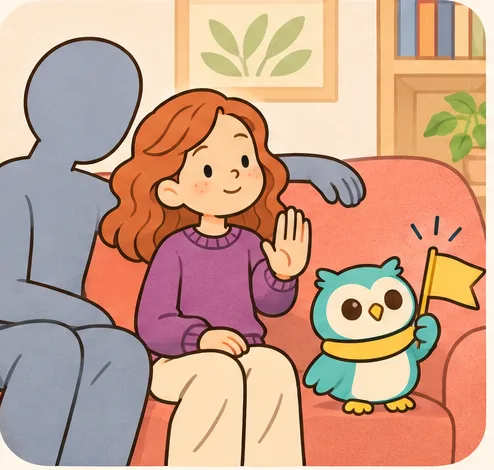
A grown-up who gets too close
An adult or older child sits too close, hugs too long or keeps tickling after your child says stop.
In the book: Scripts 5 and 26
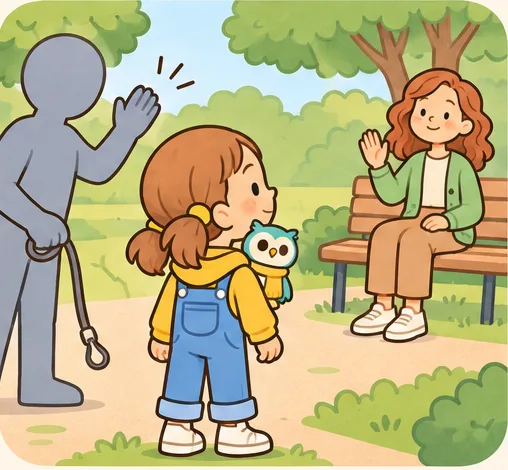
An adult who asks a child for help
"Help me find my puppy." Adults who need help ask other adults, but a child may not know that.
In the book: Scripts 21 and 23
Children who have practised the words are harder to trick, and quicker to tell you. Each script gives you the exact sentences, so you are not finding them for the first time on the day it matters.
Online safety gets a whole part of the book
Ten of the thirty scripts are about life on screens, for ages 8 to 12: who they talk to, what they share, what to do when a chat turns strange or pushy, and why telling you is always okay.
- A family tech agreement
- What is private and what is not
- Online "friends" you've never met
- When someone asks for a photo
- Threats and pressure: "you're not in trouble"
- Mean messages and cyberbullying
- Group chats, screenshots and consent
- Scary or upsetting things online
- Games, chat and moving to another app
- Passwords and fake pictures
Online safety is practised the same way as road safety: with short, repeated conversations before something goes wrong.
Most parents want to talk about safety and are not sure what to say
The best protection is many short, calm conversations over the years, so your child knows they can come to you.
Where many parents get stuck
- Long articles that are hard to use in the moment
- Warnings that frighten you more than they help
- No words to use with a young child
What this book gives you
- Short scripts with the exact words, two or three minutes each
- What your child might say back, and how to answer
- Calm, age-matched, never scary: tools, not warnings about monsters
Meet the characters
Everyone in this book is a made-up character, and so is the Hart family. The names and the people in the stories are not real people.
Pip, the safe-keeping companion
Pip is a little owl who sits beside every conversation. Pip listens, never rushes and never tells anyone off. Pip does not talk in the pictures: Pip points, waves a wing and sits close.
Often says: "Green light, red light." "Say no, then tell." "Tell again if nothing changes."
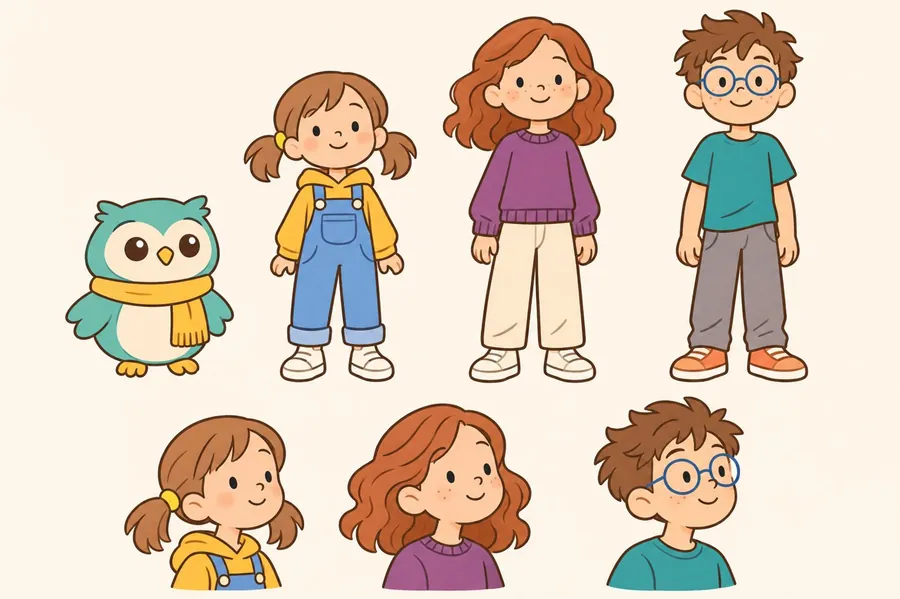
Mia Hart, age 6
Part 1 and the code word
Curious and cheerful, Mia asks "why?" about everything. She helps show the body bubble, safe and not safe touch, and secrets versus surprises.
Often says: "Can I come into your bubble?" "Why is it private?"
Zoe Hart, age 9
Parts 2 and 3
Thoughtful and kind, Zoe notices when a friend is upset. She helps with cyberbullying, kind sharing and being a good friend.
Often says: "Let's tell someone together."
Kai Hart, age 10
Parts 2 and 3
Kai loves football, games and gadgets. Kids often hear "everyone does it", so Kai helps show the online chats, games, gifts and walking to school.
Often says: "Let's check with Mum or Dad." "I'll tell Mum or Dad."
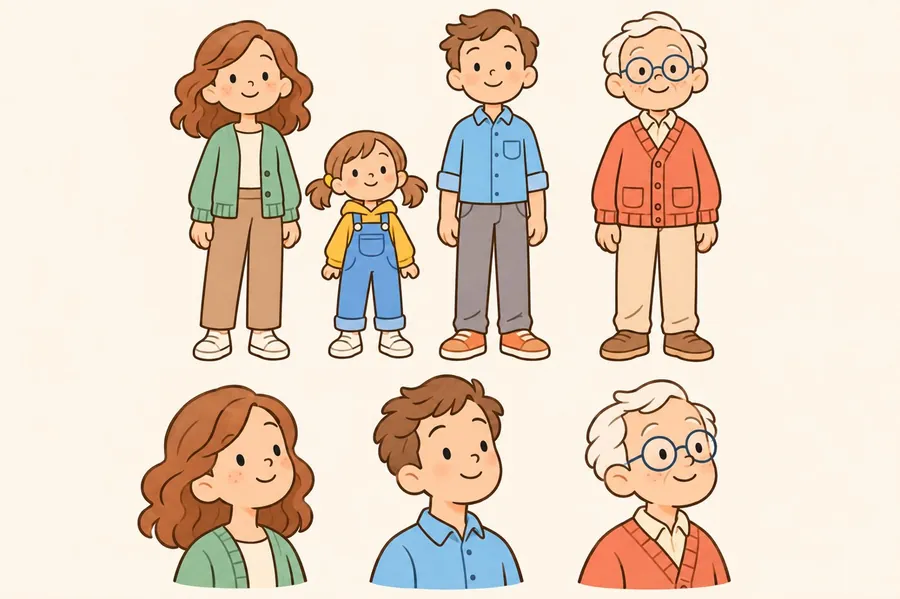
Mum Emma Hart
The listener
Calm and practical, Emma is the one who kneels down to listen. She shows how to stay steady when a child tells you something hard.
Often says: "Tell me more, I'm listening."
Dad Tom Hart
The helper
Patient and funny, Tom helps with the family tech agreement, the pick-up code word and whispered worries.
Often says: "You can tell me anything. I'll stay calm and listen."
Grandpa Joe
A trusted grown-up
Emma's dad is a gentle storyteller and a first-class high-fiver. He shows that a hug is a choice, and a high five is great too.
Often says: "No hug needed. High five?"
Fictional characters. Illustrations are drawings of an imaginary family. Any resemblance to real people is a coincidence. No photographs of real children are used.
What is inside
Thirty scripts in three parts. Read one, pick a calm moment, and say it in your own words.
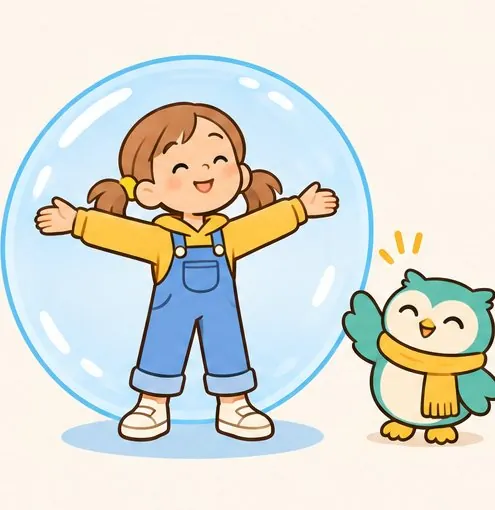
My Body, My Rules
Body safety, ages 3 to 8
- The real names of body parts
- Your body belongs to you
- Okay touch and not okay touch
- Secrets and surprises
- You can say no to hugs and tickles
- Your safety network: a hand of helpers
- Your body's early warning signs
- Privacy at home, at school and at the doctor
- If someone asks you to keep a touching secret
- Tell, and tell again if nothing changes
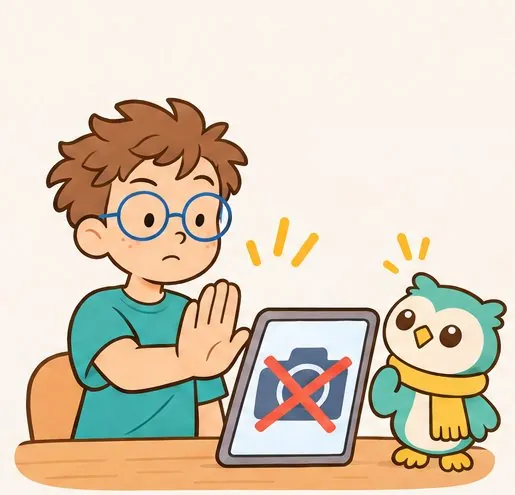
Safe Online
Online safety, ages 8 to 12
- A family tech agreement
- What is private and what is not
- Online "friends" you've never met
- When someone asks for a photo
- Threats and pressure: "you're not in trouble"
- Mean messages and cyberbullying
- Group chats, screenshots and consent
- Scary or upsetting things online
- Games, chat and moving to another app
- Passwords and fake pictures
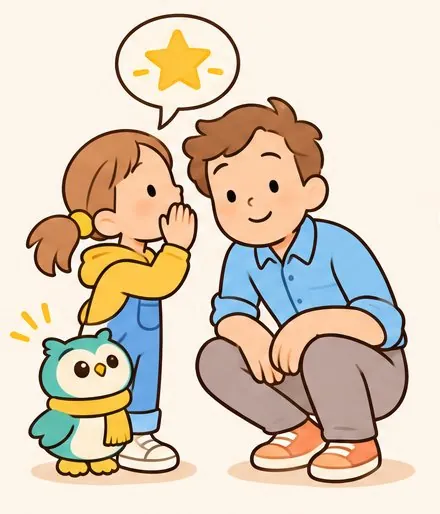
Safe Out in the World
Safety out and about, ages 5 to 12
- If you get lost
- The pick-up code word
- When an adult asks a child for help
- Walking to school and going out with friends
- Sleepovers and playdates
- Even people you know can do things that are not okay
- Gifts, favours and "special" attention
- If your child is ever home alone
- Emergencies: who to call
- Friends, dares and being a good friend
Seven printable cards
Fill in with your child, stick on the fridge or keep in a school bag. They come as separate A4 and US Letter files, and the same seven pages are at the end of the A4 and US Letter books.
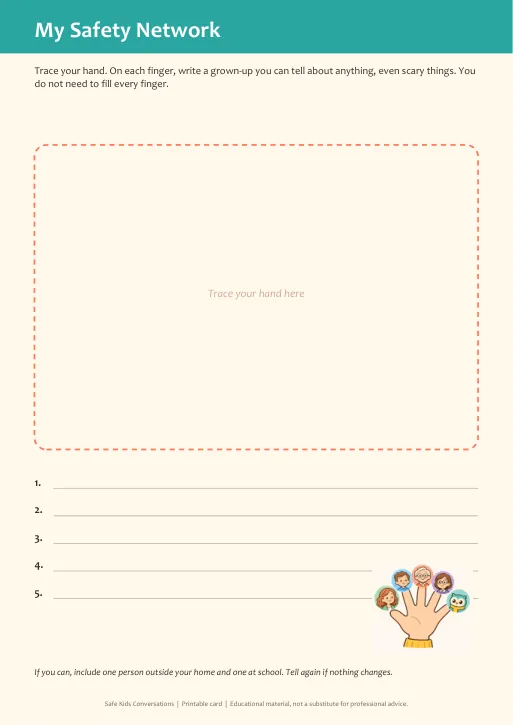
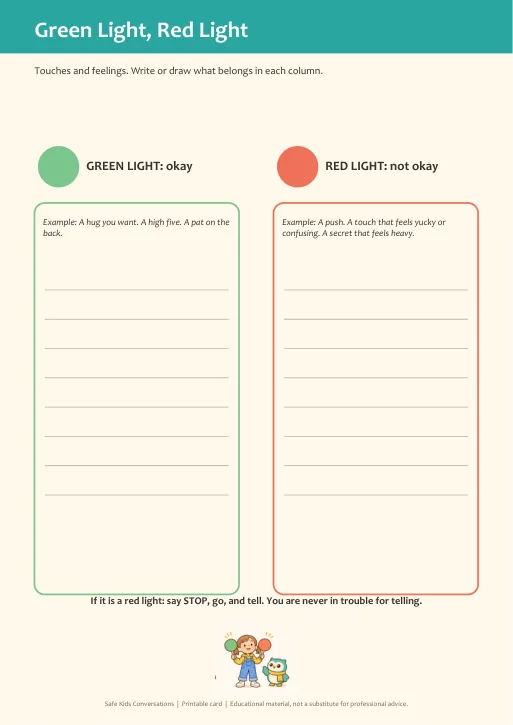
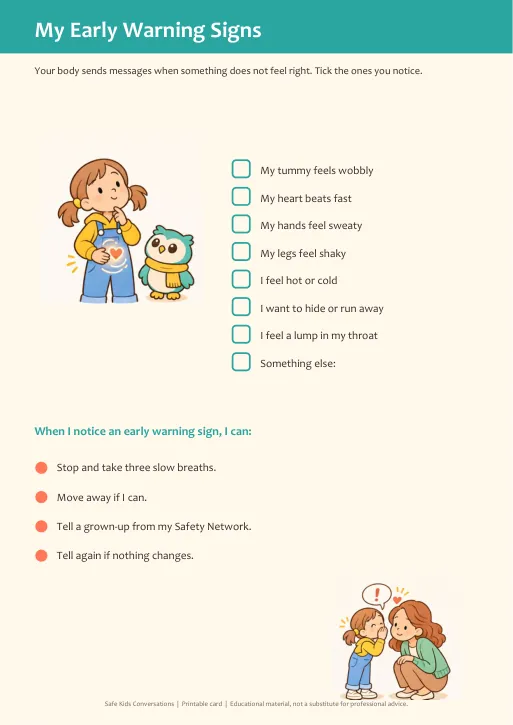
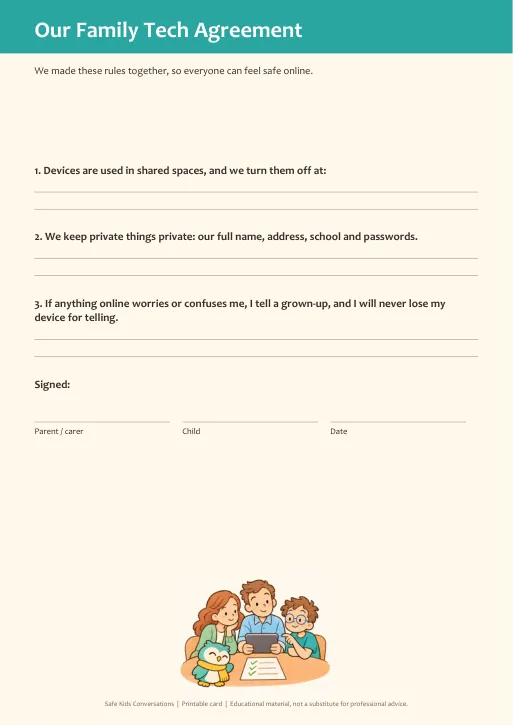
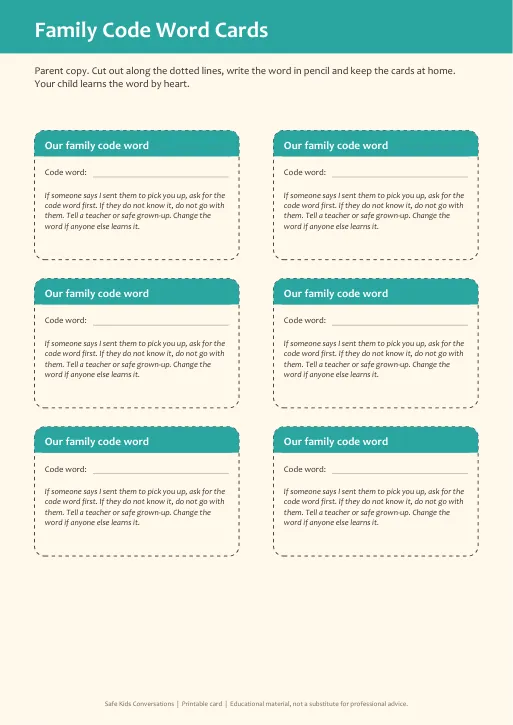
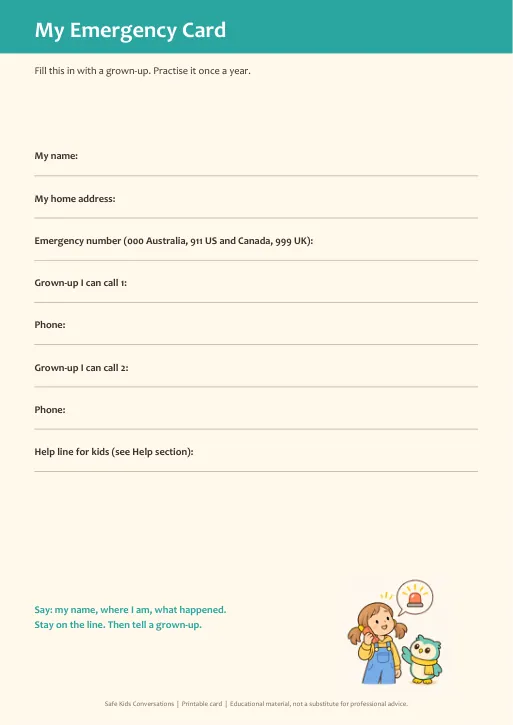
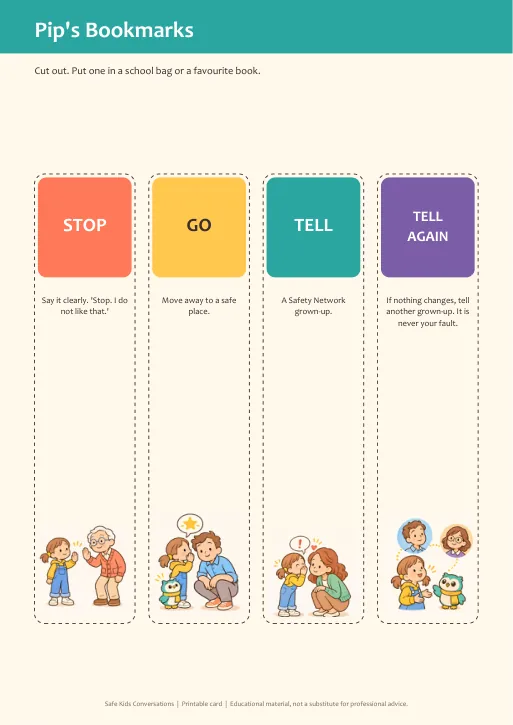
The phone-friendly book describes the cards. Print them from the A4 or US Letter files.
Read a free sample first
Download three real scripts, the welcome pages and the guide for what to do if your child tells you something. No email, no sign-up.
| Free sample | Full book | |
|---|---|---|
| Scripts | 3 (scripts 1, 12 and 22) | All 30 |
| If your child tells you | Included | Included |
| Printable cards | Not included | 7 cards, A4 and US Letter |
| Help lines (AU, US, UK, CA) | Not included | Full help card |
| PDF formats | Phone | Phone, A4 and US Letter |
Is this right for you?
A good fit if
- You are a parent, carer or teacher of a child roughly 3 to 12
- You want simple words to start calm, regular conversations
- You like to print a card for the fridge or the car
Skip it if
- A child is in danger right now (call your local emergency number)
- You need counselling, legal or medical advice (this is not that)
- You expect any book to guarantee a child's safety (none can, and children are never responsible for preventing harm)
How to use it
- 1
Pick one script
You do not need to go in order or finish the book. Choose the topic that fits your child today.
- 2
Choose a calm moment
In the car, at bath time or on a walk. Two or three minutes is plenty. Ask, then listen.
- 3
Say it again next month
Children learn safety by repetition. Use the printable cards to keep the ideas in sight.
What you get
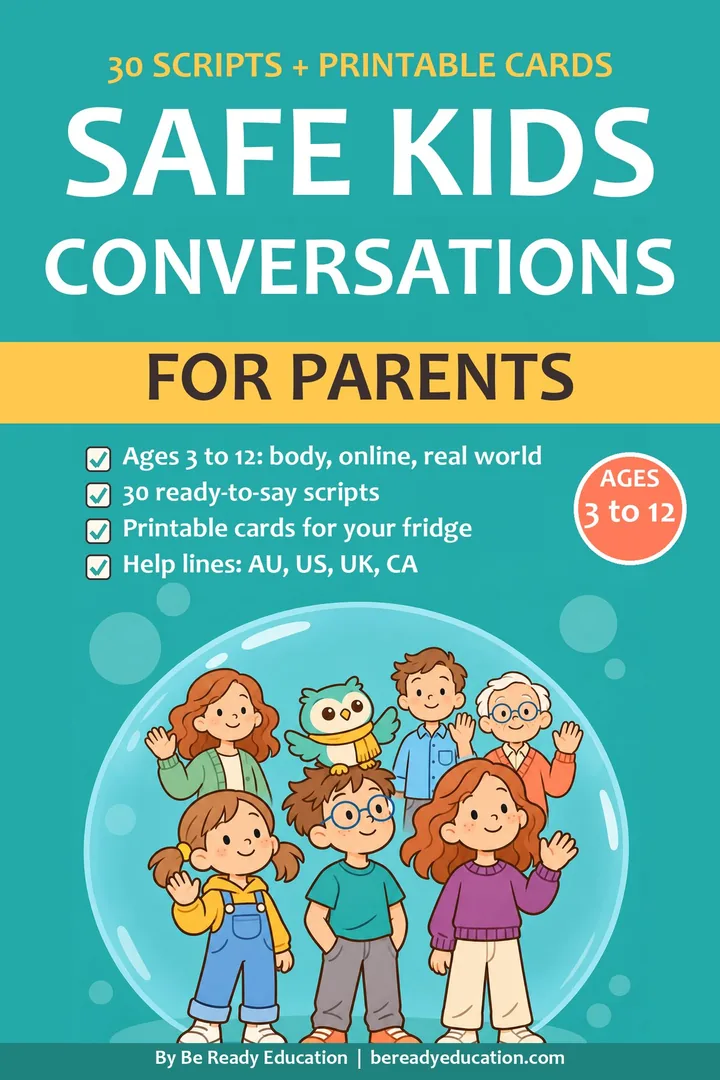
30 ready-to-say scripts
Each has words you can say, what your child might answer and one small thing to try.
Seven printable cards
Safety Network Hand, Green Light Red Light, Early Warning Signs, Family Tech Agreement, Family Code Word Cards, Emergency Card and Pip's Bookmarks.
If your child tells you
A calm eight-step guide for the moment a child tells you something worrying.
Help lines for four countries
A help card with emergency numbers and helplines for Australia, the US, the UK and Canada.
Three PDF formats
Phone-friendly for reading on a screen, A4 and US Letter for printing.
Warm, clear illustrations
Fictional characters make each script easier to share with your child.
Where the advice comes from
The book is a general-education summary based on the public advice of these organisations. It does not replace their materials or professional advice.
- eSafety Commissioner (Australia)
- Kids Helpline (Australia)
- Childhelp (US)
- National Center for Missing and Exploited Children (US)
- NSPCC and Childline (UK)
- CEOP and the Internet Watch Foundation (UK)
- Kids Help Phone (Canada)
- Canadian Centre for Child Protection
Where a script cites a specific source, the source is named at the bottom of that page. Scripts without a source line are general parenting suggestions, not citations of a specific organisation. Read the full list inside the book.
Safe Kids Conversations for Parents
US$14.99one payment, instant download
- All 30 scripts in three PDF formats (phone, A4, US Letter)
- Seven printable cards in A4 and US Letter
- The guide for what to do if your child tells you something
- Help lines for Australia, the US, the UK and Canada
- Digital download, yours to keep for personal and family use
30-day money-back guarantee. If it is not for you, ask for a refund. Read the conditions
Questions before you buy? Ask us, we reply by email.
30-day money-back guarantee
If the book is not for you, ask for a refund within 30 days of buying. The conditions are short and written in plain words on our refund policy. Your rights under the Australian Consumer Law are not affected.
Questions before you buy
Who is this book for?
Parents, carers and teachers of children roughly 3 to 12 who want simple words for conversations about body safety, online safety and staying safe out and about.
What age is it for?
Scripts are marked with an age range. Part 1 is for ages 3 to 8, Part 2 for 8 to 12 and Part 3 for 5 to 12. You choose what fits your child.
Is it a substitute for professional help?
No. It is educational material, not a substitute for professional advice or child protection services. If a child is in immediate danger, call your local emergency number (000 in Australia, 911 in the US and Canada, 999 in the UK).
Where does the advice come from?
From the public advice of organisations such as eSafety, Kids Helpline, Childhelp, NCMEC, the NSPCC and Kids Help Phone. Some scripts are general suggestions rather than citations, and the book says which.
What do I receive after paying?
You go straight to a page with your downloads, and we email you the same link. You get the phone-friendly PDF, A4 and US Letter PDFs of the book, and printable cards in A4 and US Letter. The link works for 90 days.
Can I print it?
Yes, for your own family. The A4 and US Letter files are made for printing, and the cards are ready to cut out.
Does the book guarantee my child will be safe?
No book can. Children are never responsible for stopping harm; adults are. The book gives you tools for calm, regular conversations.
What if it is not for me?
Ask for a refund within 30 days. See the conditions on the refund policy page.
Do you collect any information about my child?
No. We never ask for anything about children. At checkout Stripe collects your payment details and email address, which we use to deliver the book and give support.
Start the conversation, one calm script at a time
30 scripts, printable cards, help lines and a 30-day money-back guarantee.
Last updated 8 November 2026. Educational material, not a substitute for professional advice or child protection services. This book is not legal or medical advice, and laws and services differ by place. If a child is in immediate danger, call your local emergency number (000 in Australia, 911 in the US and Canada, 999 in the UK). Independent publisher, not affiliated with any government or any of the organisations named. No resource can guarantee a child's safety. Terms · Refund policy · Privacy.